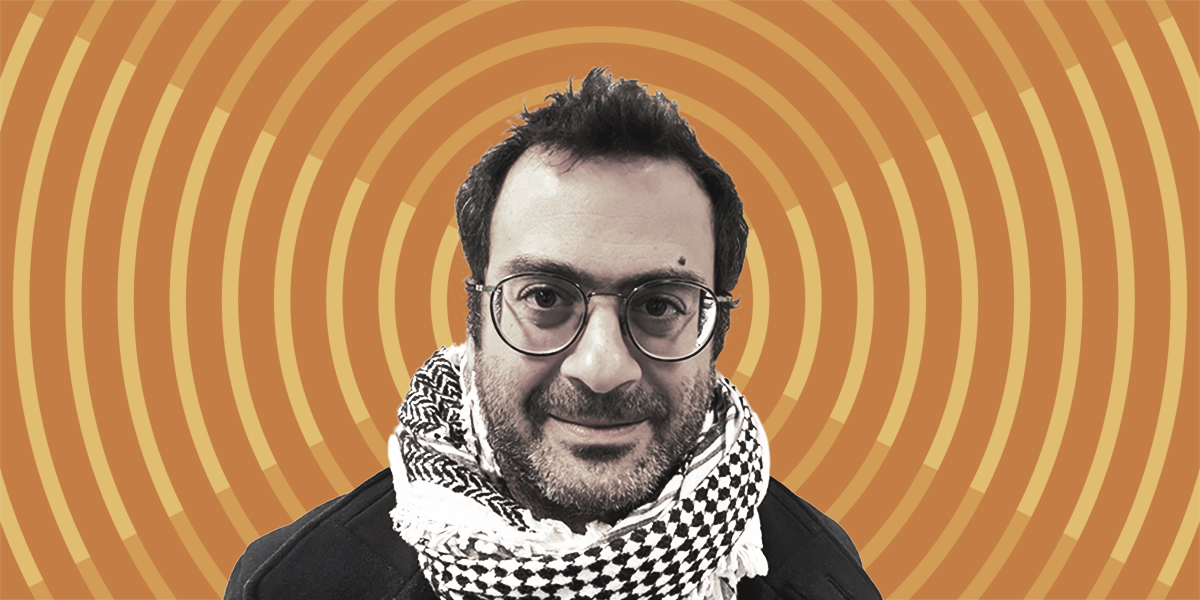
Interviewer: Jillian York
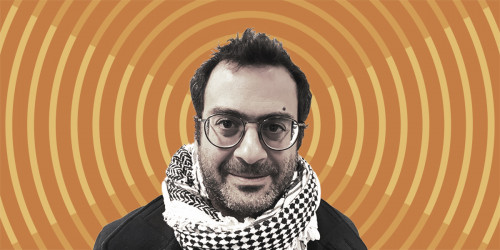
Yazan Badran is an assistant professor in international media and communication studies at the Vrije Universiteit Brussel, and a researcher at the Echo research group. His research focuses on the intersection between media, journalism and politics particularly in the MENA region and within its exilic and diasporic communities.
*This interview has been edited for length and clarity.
Jillian York: What does free speech or free expression mean to you?
Yazan Badran: So I think there are a couple of layers to that question. There's a narrow conception of free speech that is related to, of course, your ability to think about the world.
And that also depends on having the resources to be able to think about the world, to having resources of understanding about the world, having resources to translate that understanding into thoughts and analysis yourself, and then being able to express that in narratives about yourself with others in the world. And again, that also requires resources of expression, right?
So there's that layer, which means that it's not simply the absence of constraints around your expression and around your thinking, but actually having frameworks that activate you expressing yourself in the world. So that's one element of free expression or free speech, or however you want to call it.
But I feel that remains too narrow if we don't account also for the counterpart, which is having frameworks that listen to you as you express yourself into the world, right? Having people, institutions, frameworks that are actively also listening, engaging, recognizing you as a legitimate voice in the world. And I think these two have to come together in any kind of broad conception of free speech, which entangles you then in a kind of ethical relationship that you have to listen to others as well, right? It becomes a mutual responsibility from you towards the other, towards the world, and for the world towards you, which also requires access to resources and access to platforms and people listening to you.
So I think these two are what I, if I want to think of free speech and free expression, I would have to think about these two together. And most of the time there is a much narrower focus on the first, and somewhat neglecting the second, I think.
JY: Yeah, absolutely. Okay, now I have to ask, what is an experience that shaped these views for you?
YB: I think two broad experiences. One is the…let's say, the 2000s, the late 2000s, so early 2010 and 2011, where we were all part of this community that was very much focused on expression and on limiting the kind of constraints around expression and thinking of tools and how resources can be brought towards that. And there were limits to where that allowed us to go at a certain point.
And I think the kind of experiences of the Arab uprisings and what happened afterwards and the kind of degeneration across the worlds in which we lived kind of became a generative ground to think of how that experience went wrong or how that experience fell short.
And then building on that, I think when I started doing research on journalism and particularly on exiled journalists and thinking about their practice and their place in the world and the fact that in many ways there were very little constraints on what they could do and what they could voice and what they could express, et cetera.
Not that there are no constraints, there are always constraints, but that the nature of constraints were different - they were of the order of listening; who is listening to this? Who is on the other side? Who are you engaged in a conversation with? And that was, from speaking to them, a real kind of anxiety that came through to me.
JY: I think you're sort of alluding to theory of change…
YB: Yes, to some extent, but also to…when we think about our contribution into the world, to what kind of the normative framework we imagine. As people who think about all of these structures that circulate information and opinion and expressions, et cetera, there is often a normative focus, where there should be, about opening up constraints around expression and bringing resources to bear for expression, and we don't think enough of how these structures need also to foster listening and to foster recognition of these expressions.
And that is the same with, when we think about platforms on the internet and when we think about journalism, when we think about teaching… For example, in my field, when we think about academic research, I think you can bring that framework in different places where expression is needed and where expression is part of who we are. Does that make sense?
JY: Absolutely. It absolutely makes sense. I think about this all the time. I'm teaching now too, and so it's very, very valuable. Okay, so let's shift a little bit. You're from Syria. You've been in Brussels for a long time. You were in Japan in between. You have a broad worldview, a broad perspective. Let’s talk about press freedom.
YB: Yeah, I've been thinking about this because, I mean, I work on journalism and I'm trying to do some work on Syria and what is happening in Syria now. And I feel there are times where people ask me about the context for journalistic work in Syria. And the narrow answer and the clear answer is that we've never had more freedom to do journalism in the country, right? And there are many reasons. Part of it is that this is a new regime that perhaps doesn't still have complete control over the ground. There are differentiated contexts where in some places it's very easy to go out and to access information and to speak to people. In other places, it's less easy, it's more dangerous, etc. So it's differentiated and it's not the same everywhere.
But it's clear that journalists come out and in from Syria. They can do their job relatively unmolested, which is a massive kind of change, contrast to the last thirteen or fourteen years where Syria was an information black hole. You couldn't do anything.
But that remains somewhat narrow in thinking about journalism in Syria. What is journalism about Syria in this context? What kind of journalism do we need to be thinking about? In a place that is in, you know, ruins, if not material destruction, then economic and societal disintegration, et cetera. So there are, I think, two elements. Sure, you can do journalism, but what kind of journalism is being done in Syria? I feel that we have to be asking a broader question about what is the role of information now more broadly in Syria?
And that is a more difficult question to answer, I feel. Or a more difficult question to answer positively. Because it highlights questions about who has access to the means of journalism now in Syria? What are they doing with it? Who has access to the sources, and can provide actual understanding about the political or economic developments that are happening in the country. Very few people who have genuine understanding of the processes are going into building a new regime, a new state. In general, we have very, very little access. There are few avenues to participate and gain access to what is happening there.
So sure, you can go on the ground, you can take photos, you can speak to people, but in terms of participating in that broader nation-building exercise that is happening; this is happening at a completely different level to the places that we have access to. And with few exceptions, journalism as practiced now is not bringing us closer to these spaces.
In a narrow sense, it's a very exciting time to be looking at experiments in doing journalism in Syria, to also be seeing the interaction between international journalists and local journalists and also the kind of tensions and collaborations and discussion around structural inequalities between them; especially from a researcher’s perspective. But it remains very, very narrow. In terms of the massive story, which is a complete revolution in the identity of the country, in its geopolitical arrangement, in its positioning in the world, and that we have no access to whatsoever. This is happening well over our heads—we are almost bystanders.
JY: That makes sense. I mean, it doesn't make sense, but it makes sense. What role does the internet and maybe even specifically platforms or internet companies play in Syria? Because with sanctions lifted, we now have access to things that were not previously available. I know that the app stores are back, although I'm getting varied reports from people on the ground about how much they can actually access, although people can download Signal now, which is good. How would you say things have changed online in the past year?
YB: In the beginning, platforms, particularly Facebook, and it's still really Facebook, were the main sphere of information in the country. And to a large extent, it remains the main sphere where some discussions happen within the country.
These are old networks that were reactivated in some ways, but also public spheres that were so completely removed from each other that opened up on each other after December. So you had really almost independent spheres of activity and discussion. Between areas that were controlled by the regime, areas that were controlled by the opposition, which kind of expanded to areas of Syrian refugees and diaspora outside.
And these just collapsed on each other after 8th of December with massive chaos, massive and costly chaos in some ways. The spread of disinformation, organic disinformation, in the first few months was mind-boggling. I think by now there's a bit of self-regulation, but also another movement of siloing, where you see different clusters hardening as well. So that kind of collapse over the first few months didn't last very long.
You start having conversations in isolation of each other now. And I'm talking mainly about Facebook, because that is the main network, that is the main platform where public discussions are happening. Telegram was the public infrastructure of the state for a very long time, for the first six months. Basically, state communication happened through Telegram, through Telegram channels, also causing a lot of chaos. But now you have a bit more stability in terms of having a news agency. You have the television, the state television. So the importance of Telegram has waned off, but it's still a kind of parastructure of state communication, it remains important.
I think more structurally, these platforms are basically the infrastructure of information circulation because of the fact that people don't have access to electricity, for example, or for much of the time they have very low access to bandwidth. So having Facebook on their phone is the main way to keep in touch with things. They can't turn on the television, they can't really access internet websites very easily. So Facebook becomes materially their access to the world. Which comes with all of the baggage that these platforms bring with them, right? The kind of siloing, the competition over attention, the sensationalism, these clustering dynamics of these networks and their algorithms.
JY: Okay, so the infrastructural and resource challenges are real, but then you also have the opening up for the first time of the internet in many, many years, or ever, really. And as far as I understand from what friends who’ve been there have reported, is that nothing being blocked yet. So what impact do you see or foresee that having on society as people get more and more online? I know a lot of people were savvy, of course, and got around censorship, but not everyone, right?
YB: No, absolutely, absolutely not everyone. Not everyone has the kind of digital literacy to understand what going online means, right? Which accounts for one thing, the avalanche of fake information and disinformation that is now Syria, basically.
JY: It's only the second time this has happened. I mean, Tunisia is the only other example I can think of where the internet just opened right up.
YB: Without having gateways and infrastructure that can kind of circulate and manage and curate this avalanche of information. While at the same time, you have a real disintegration in the kind of social institutions that could ground a community. So you have really a perfect storm of a thin layer of digital connectivity, for a lot of people who didn't have access to even that thin layer, but it's still a very thin layer, right? You're connecting from your old smartphone to Facebook. You're getting texts, et cetera, and perhaps you're texting with the family over WhatsApp. And a real collapse of different societal institutions that also grounded you with others, right? The education system, of different clubs and different neighborhoods, small institutions that brought different communities together of the army, for example, universities, all of these have been disrupted over the past year in profound ways and along really communitarian ways as well. I don't know the kind of conditions that this creates, the combination of these two. But it doesn't seem like it's a positive situation or a positive dynamic.
JY: Yeah, I mean, it makes me think of, for example, Albania or other countries that opened up after a long time and then all of a sudden just had this freedom.
YB: But still combined, I mean, that is one thing, the opening up and the avalanche, and that is a challenge. But it is a challenge that perhaps within a settled society with some institutions in which you can turn to, through which you can regulate this, through which you can have countervailing forces and countervailing forums for… that’s one thing. But with the collapse of material institutions that you might have had, it's really creating a bewildering world for people, where you turn back and you have your family that maybe lives two streets away, and this is the circle in which you move, or you feel safe to move.
Of course, for certain communities, right? That is not the condition everywhere. But that is part of what is happening. There's a real sense of bewilderment in the kind of world that you live in. Especially in areas that used to be controlled by the regime where everything that you've known in terms of state authority, from the smallest, the lowliest police officer in your neighborhood, to people, bureaucrats that you would talk to, have changed or your relationship to them has fundamentally changed. There's a real upheaval in your world at different levels. And, you know, and you're faced with a swirling world of information that you can't make sense out of.
JY: I do want to put you on the spot with a question that popped into my head, which is, I often ask people about regulation and depending on where they're working in the world, especially like when I'm talking to folks in Africa and elsewhere. In this case, though, it's a nation-building challenge, right? And so—you're looking at all of these issues and all of these problems—if you were in a position to create press or internet regulation from the ground up in Syria, what do you feel like that should look like? Are there models that you would look to? Are there existing structures or is there something new or?
YB: I think maybe I don't have a model, but I think maybe a couple of entry points that you would kind of use to think of what model of regulation you want is to understand that there the first challenge is at the level of nation building. Of really recreating a national identity or reimagining a national identity, both in terms of a kind of shared imaginary of what these people are to each other and collectively represent, but also in terms of at the very hyper-local level of how these communities can go back to living together.
And I think that would have to shape how you would approach, say, regulation. I mean, around the Internet, that's a more difficult challenge. But at least in terms of your national media, for example, what is the contribution of the state through its media arm? What kind of national media do you want to put into place? What kind of structures allow for really organic participation in this project or not, right? But also at the level of how do you regulate the market for information in a new state with that level of infrastructural destruction, right? Of the economic circuit in which these networks are in place. How do you want to reconnect Syria to the world? In what ways? For what purposes?
And how do you connect all of these steps to open questions around identity and around that process of national rebuilding, and activating participation in that project, right? Rather than use them to foreclose these questions.
There are also certain challenges that you have in Syria that are endogenous, that are related to the last 14 years, to the societal disintegration and geographic disintegration and economic disintegration, et cetera. But on top of that, of course, we live in an information environment that is, at the level of the global information environment, also structurally cracking down in terms of how we engage with information, how we deal with journalism, how we deal with questions of difference. These are problems that go well beyond Syria, right? These are difficult issues that we don't know how to tackle here in Brussels or in the US, right? And so there's also an interplay between these two. There's an interplay between the fact that even here, we are having to come to terms with some of the myths around liberalism, around journalism, the normative model of journalism, of how to do journalism, right? I mean, we have to come to terms with it. The last two years—of the Gaza genocide—didn't happen in a vacuum. It was earth shattering for a lot of these pretensions around the world that we live in. Which I think is a bigger challenge, but of course it interacts with the kind of challenges that you have in a place like Syria.
JY: To what degree do you feel that the sort of rapid opening up and disinformation and provocations online and offline are contributing to violence?
YB: I think they're at the very least exacerbating the impact of that violence. I can't make claims about how much they're contributing, though I think they are contributing. I think there are clear episodes in which the kind of the circulation of misinformation online, you could directly link it to certain episodes of violence, like what happened in Jaramana before the massacre of the Druze. So a couple of weeks before the Druze, there was this piece of disinformation that led to actual violence and that set the stage to the massive violence later on. During the massacres on the coast, you could also link the kind of panic and the disinformation around the attacks of former regime officers and the effects of that to the mobilization that has happened. The scale of the violence is linked to the circulation of panic and disinformation. So there is a clear contribution. But I think the greater influence is how it exacerbates what happens after that violence, how it exacerbates the depth, for example, of divorce between between the population of Sweida after the massacre, the Druze population of Sweida and the rest of Syria. That is tangible. And that is embedded in the kind of information environment that we have. There are different kinds of material causes for it as well. There is real structural conflict there. But the kind of ideological, discursive, and affective, divorce that has happened over the past six months, that is a product of the information environment that we have.
JY: You are very much a third country, 4th country kid at this point. Like me, you connected to this global community through Global Voices at a relatively young age. In what ways do you feel that global experience has influenced your thinking and your work around these topics, around freedom of expression? How has it shaped you?
YB: I think in a profound way. What it does is it makes you to some extent immune from certain nationalist logics in thinking about the world, right? You have stakes in so many different places. You've built friendships, you've built connections, you've left parts of you in different places. And that is also certainly related to certain privileges, but it also means that you care about different places, that you care about people in many different places. And that shapes the way that you think about the world - it produces commitments that are diffused, complex and at times even contradictory, and it forces you to confront these contradictions. You also have experience, real experience in how much richer the world is if you move outside of these narrow, more nationalist, more chauvinistic ways of thinking about the world. And also you have kind of direct lived experience of the complexity of global circulation in the world and the fact, at a high level, it doesn't produce a homogenized culture, it produces many different things and they're not all equal and they're not all good, but it also leaves spaces for you to contribute to it, to engage with it, to actively try to play within the little spaces that you have.
JY: Okay, here’s my final question that I ask everyone. Do you have a free speech hero? Or someone who's inspired you?
YB: I mean, there are people whose sacrifices humble you. Many of them we don't know by name. Some of them we do know by name. Some of them are friends of ours. I keep thinking of Alaa [Abd El Fattah], who was just released from prison—I was listening to his long interview with Mada Masr (in Arabic) yesterday, and it’s…I mean…is he a hero? I don’t know but he is certainly one of the people I love at a distance and who continues to inspire us.
JY: I think he’d hate to be called a hero.
YB: Of course he would. But in some ways, his story is a tragedy that is inextricable from the drama of the last fifteen years, right? It’s not about turning him into a symbol. He's also a person and a complex person and someone of flesh and blood, etc. But he's also someone who can articulate in a very clear, very simple way, the kind of sense of hope and defeat that we all feel at some level and who continues to insist on confronting both these senses critically and analytically.
JY: I’m glad you said Alaa. He’s someone I learned a lot from early on, and there’s a lot of his words and thinking that have guided me in my practice.
YB: Yeah, and his story is tragic in the sense that it kind of highlights that in the absence of any credible road towards collective salvation, we're left with little moments of joy when there is a small individual salvation of someone like him. And that these are the only little moments of genuine joy that we get to exercise together. But in terms of a broader sense of collective salvation, I think in some ways our generation has been profoundly and decisively defeated.
JY: And yet the title of his book, “you have not yet been defeated.”
YB: Yeah, it's true. It's true.
JY: Thank you Yazan for speaking with me.